
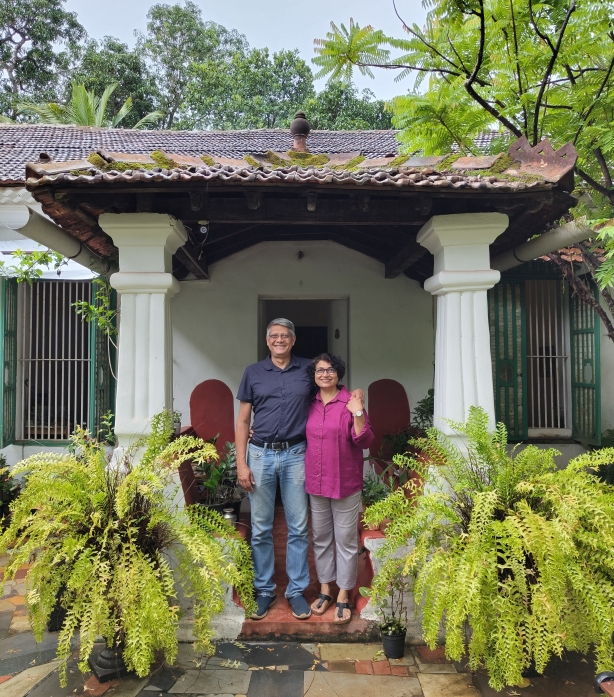
Goa’s green design warriors Part I – Dean D’Cruz

By Neena Bhandari

Sydney, 02.08.2024 (The Hindu): In a burgeoning real estate market, three eminent architects – Dean D’Cruz, Gerard da Cunha and Arminio Ribeiro – go down memory lane and reflect on how Goa has transformed from a tranquil haven into a bustling hub as tourism and construction take centerstage. They underscore the need for environmentally and socially responsible policies and planning to foster sustainable communities, where cultural heritage and modern development can coexist in harmony.

Dean D’Cruz, co-founder and principal architect of Mozaic, recalls waking up to a rooster crowing and the aroma of curries simmering on woodfired stoves in his uncle’s home, where the extended family lived together. It was a cohesive existence that permeated their village, Saligao, in Goa.

He has meticulously restored his 105-year-old Portuguese-style villa, nestled in a quiet green corner of Saligao, where I meet him on a rainy evening. The home has been progressively restored from about 50 years ago. A staircase leads to the balcao (a porch) that overlooks a courtyard garden. The main verandah features columns crafted from single pieces of Burma teak and the flooring is adorned with Spanish-Portuguese tiles. Inside, two spacious living rooms with original oyster shell windows with pointed arches, flank the entrance. The use of shells is now banned, instead frosted glass can be used in the pointed arches.

Continue reading →

Goa’s green design warriors Part II – Gerard da Cunha

By Neena Bhandari

Sydney, 02.08.2024 (The Hindu): Gerard da Cunha’s quest to discover his roots led him to Goa at the impressionable age of 19. His maternal grandparents had moved to Lahore and his paternal grandparents to Mumbai. His father worked in a bank and so they lived in various cities, wherever he was posted. During summer vacations, they would visit one set of grandparents, but never Goa.

He instantly fell in love with the place, especially it’s architecture, and decided to make Goa his home as soon as it were possible. After graduating from the School of Planning and Architecture in Delhi and working in the national capital for few years, he felt it was time to set up his architectural practice in Goa in 1984.

He was intrigued by the Indo-Portuguese house, which harmoniously blends the double-storey rural Portuguese house and the traditional Goan house designs. He began documenting and photographing these houses, and published the seminal Houses of Goa book written by Heta Pandit and Annabel Mascarenhas in 1999. Around the same time, he held an exhibition of Goan houses in Panjim, which travelled to Lisbon and Porto, Mumbai and Delhi.

Continue reading →

Goa’s green design warriors Part III – Arminio Ribeiro

By Neena Bhandari

Sydney, 02.08.2024 (The Hindu): Arminio Ribeiro’s ancestral home, built by his grandfather in 1915, is a stone’s throw from the whitewashed Saint Sebastian chapel in Fontainhas – Goa’s oldest Latin quarter, tucked away from the din of the capital city, Panjim. He returned to this home of his birth in 2000, drawn by the familiar neighborhood and its close-knit community.

“It was like returning to a large joint family with its share of fun and occasional friction”, says Ribeiro, whom I meet in the rear part of the house, which has been his office since 1996.

Many families, like Ribeiro’s, have resided for generations in Fontainhas, which was originally part of Talegaon village. It is only around mid-19th century, with the administration relocating to Panjim from Old Goa, that urbanization plans began to take shape, connecting residential and work areas.

Continue reading →