
Category Health & Science

India V/s Australia: सिडनी का ग्राउंड गुलाबी क्यों हो गया था?

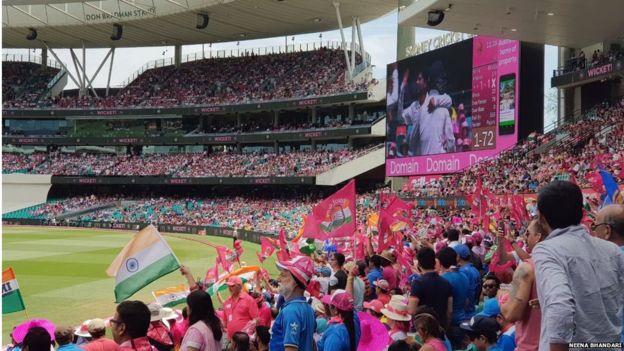
भारत और ऑस्ट्रेलिया के बीच खेले जा रहे पिंक टेस्ट मैच के तीसरे दिन सिडनी का हरा-भरा ग्राउंड गुलाबी हो गया. स्तन कैंसर के प्रति जागरुकता फैलाने के लिए यहां क्रिकेट और संस्कृति का अनोखा संगम देखने को मिला. मीडिया रिपोर्ट्स के मुताबिक ग्राउंड पर गुलाबी साड़ी पहने कम-से-कम सौ महिलाएं मौजूद थीं, जो ब्रेस्ट स्क्रीनिंग और केयर के प्रति जागरुकता फैलाने के लिए आईं थीं. ना सिर्फ औरतों बल्कि मर्दों ने भी गुलाबी पगड़ी, कमीज़ और टोपी पहनकर इस अभियान का समर्थन किया.

Continue reading on BBC Indian Languages:

BBC Hindi: https://www.bbc.com/hindi/sport-46772040

BBC Punjabi: https://www.bbc.com/punjabi/international-46770190

BBC Telugu: https://www.bbc.com/telugu/international-46772983

English Translation: English Translation of Pink Sari

© Copyright Neena Bhandari and BBC Indian Languages. All rights reserved. Republication, copying or using information from neenabhandari.com content is expressly prohibited without the permission of the writer and the media outlet syndicating or publishing the article.

Healthcare eludes poorer women in rural Asia Pacific

By Neena Bhandari

Sydney, 21.12.2018 (SciDev.Net): Rural women in low-income households cannot access healthcare services due to distance and financial reasons. However, overall, healthcare access has improved in 27 countries of the Asia Pacific region over the past decade, says a new joint report by the Organisation for Economic Co-operation and Development (OECD) and the World Health Organization (WHO).

Health at a Glance Asia-Pacific 2018 notes that in Nepal and the Solomon Islands, about three in four women with the lowest household income reported difficulties in accessing healthcare due to financial reasons; two in three reported having unmet care needs due to distance.

The report highlights that achieving Universal Health Coverage and the Sustainable Development Goals (SDGs) is based on the “leave no one behind” premise.

Continue reading on SciDev.Net Asia & Pacific edition

© Copyright Neena Bhandari and BBC Indian Languages. All rights reserved. Republication, copying or using information from neenabhandari.com content is expressly prohibited without the permission of the writer and the media outlet syndicating or publishing the article.

Aussie project to ensure AI remains rights-centred

By Neena Bhandari

Sydney, 31.07.2018 (SciDev.Net): Recognising that artificial intelligence (AI) carries both risks and benefits for society, the Australian Human Rights Commission, an independent Statutory organisation, launched this month (July) a major project on the impact of technology on the right to life, privacy, security, safety and equality, which could also have implications in many developing countries keen on adapting emerging technologies.

AI is already employed in designing driverless cars that reduce road traffic deaths and robots that can perform minimally invasive surgeries. AI also finds use in robotic weapons deployed in conflict situations and plays a role in decision making that impacts public health, livelihoods, social interaction and human rights.

An outline of the project, published in an Issues Paper, focuses on protection and promotion of human rights in AI-informed decision making in Australia, but will promote an international approach with UN support.

Continue reading on SciDev.Net Asia & Pacific edition

© Copyright Neena Bhandari. All rights reserved. Republication, copying or using information from neenabhandari.com content is expressly prohibited without the permission of the writer and the media outlet syndicating or publishing the article